Chapter 01
Start with the room and the seats
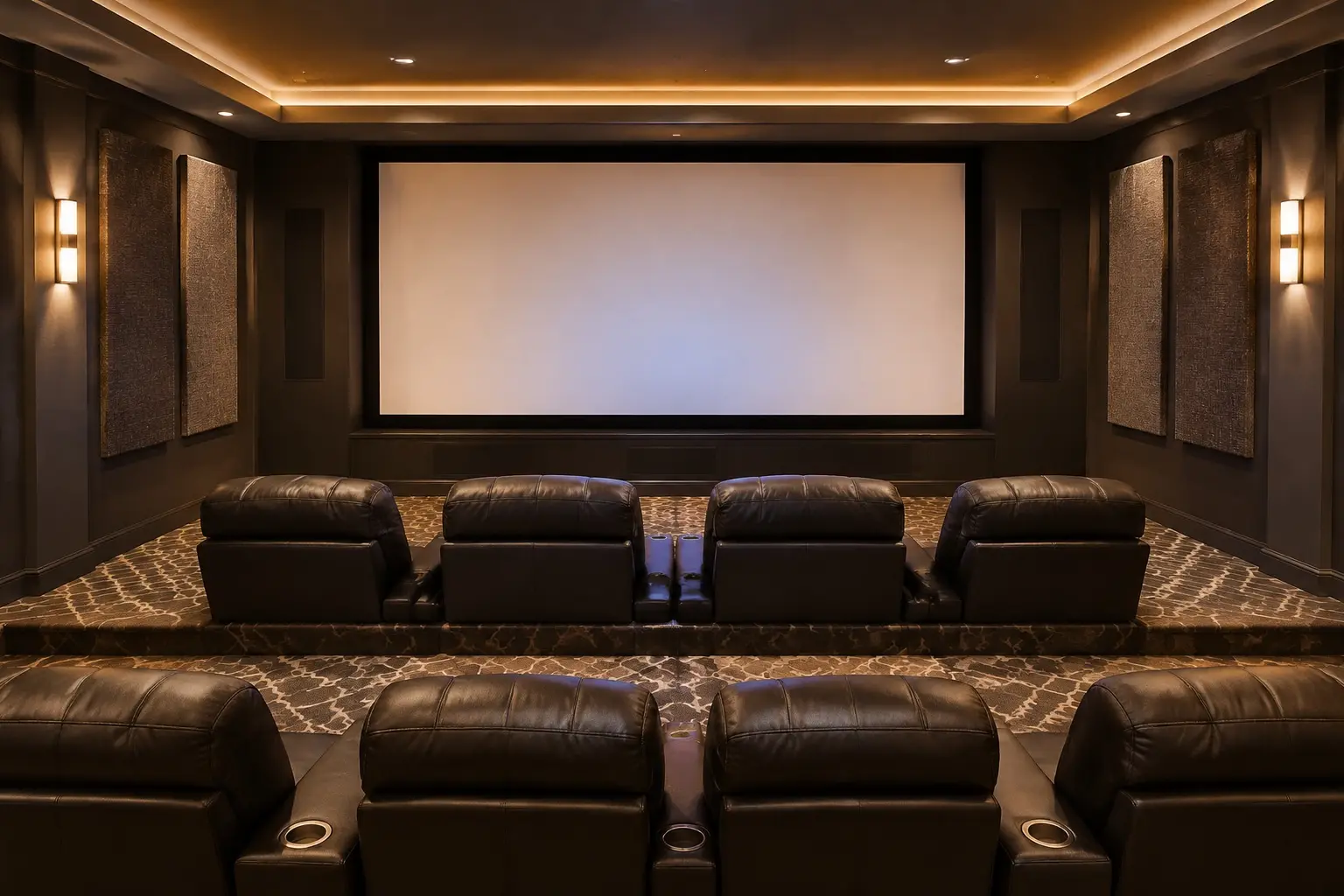
Every decision in a theater follows from two measurements: where people sit and how far that is from the screen wall. Take those first, before any equipment is discussed.
Screen size follows seating distance, not wall size. A screen too large for the distance makes you scan rather than watch and exposes every weakness in the source material; too small and the room feels wasted. The usable range is wide, but it is a range, and it is set by the seats.
Seating position then sets everything else: the speaker layout, the subwoofer placement, where the equipment lives, and whether a second row needs a riser to see over the first.
Basement rooms in Colorado houses are the most common theater space, and they bring specific constraints: ceiling height after ducting, support columns, stair landings, egress windows and mechanical noise. Those are worth measuring before anything is ordered rather than designed around afterwards.
Chapter 02
Display choice, honestly
A television and a projector solve different problems, and the room decides which.
A large flat panel is brighter, simpler, needs no light control to be watchable, and is the right answer in a great room or any space with windows, which covers most Colorado family rooms with their big west-facing glass.
A projector gives a genuinely cinematic image at a size no panel matches, in exchange for needing real light control, a throw distance the room must accommodate, a proper screen surface and periodic lamp or laser attention. In a finished basement with no windows, it is often the better experience.
The honest version of this conversation includes what the room cannot do. A projector in a room with uncontrolled daylight will disappoint whatever it cost, and we would rather say that during planning than after installation.
Chapter 03
Speaker layout that the room allows
Surround layouts have standards, and real rooms rarely match them. The useful approach is to get the important things right and compromise on the rest knowingly.
The front three speakers matter most, because almost all dialogue comes from the centre and the left and right carry the bulk of the music and effects. They should be at ear height when seated, with the centre as close to the screen's acoustic centre as the installation allows.
Surrounds belong beside and slightly behind the seating at or just above ear height, not in the back corners where they usually end up. Height or ceiling speakers for object-based formats need to be in front of and behind the seats, not directly over them.
Subwoofer placement is the one that rewards experiment: bass behaviour depends on room dimensions, and moving a subwoofer a few feet often changes more than buying a larger one. Two smaller subwoofers in different positions usually beat one large one in the wrong place.
Chapter 04
Acoustics beat equipment
The most common way a theater disappoints is acoustic, not electronic. A hard-surfaced basement room with drywall, a tile or laminate floor and no soft furnishing produces reflections that smear dialogue and make everything louder without making it clearer.
The fixes are unglamorous and effective. Something absorptive on the first reflection points at the side walls and the ceiling in front of the seats. A rug on a hard floor. Soft furnishing at the back of the room. Bass trapping in the corners, where low-frequency energy accumulates.
A modest system in a treated room comfortably outperforms an expensive one in an untreated one, and treatment costs a fraction of a speaker upgrade.
Noise control is the other half. In Colorado basements, duct runs, furnace and air handler noise, and sump pumps all sit close to theater rooms. Isolating or routing around them is worth doing during construction, when it is cheap.
Chapter 05
Light, and controlling it
A theater needs darkness when it matters and usable light the rest of the time, which is a controls problem rather than a fixture problem.
For a dedicated room: dimmable fixtures on at least two zones, one for the main area and one for aisles or steps, with no fixture aimed at the screen and none in a position where it reflects off the screen surface. Low-level step and aisle lighting lets people move without stopping the film.
For a great room theater, the issue is daylight. Motorised shades on the main glass are the single most effective improvement, and in Colorado they do double duty against the intense high-altitude afternoon sun that fades furnishings and overwhelms any display.
Tie the lighting to the system so that starting a film dims the room and pausing brings it partway up. That integration is what makes a theater feel finished, and it needs the cable and the control decisions made in advance.
Chapter 06
Equipment location, heat and control
Decide early where the equipment lives, because it determines the cabling.
A closet or a nearby mechanical space keeps noise and heat out of the room and puts everything on one rack, in exchange for needing cable from that location to the display, the speakers and the control positions. A cabinet in the room is simpler but puts fan noise and heat where you are sitting.
Either way, ventilation is not optional: amplifiers and processors in an unventilated enclosed cabinet will run hot and fail early. Plan airflow deliberately.
Control should end up as one remote or one app that the household can use without instruction. A theater that requires knowing which of four remotes selects which input is a theater that gets used less. That integration, like the lighting, depends on cable and configuration decided before the walls close.
Chapter 07
Cable it once
If the room is under construction or being finished, this is the list.
Two HDMI-capable runs in conduit from the equipment location to the display or projector position, because standards change and conduit lets you replace the cable without opening the wall. Speaker cable to every speaker location including the height channels you might add later. Network cable to the equipment location and the display, plus a ceiling access point position. Two runs to each control or keypad position. Subwoofer cable to at least two candidate positions, since placement is experimental. Power circuits planned with the equipment load in mind, and a dedicated circuit where the system warrants it.
Then label both ends and keep a diagram.
The conduit to the projector or display is the single most valuable item on that list. Every other cable type on it has changed at least once in the last fifteen years, and conduit is what makes the next change an afternoon rather than a renovation.
Primary sources worth reading yourself:
Colorado Revised Statutes, Colorado General AssemblyColorado Department of Regulatory Agencies, licensing and the State Electrical BoardFederal Trade Commission guidance on connected devices and account securityColorado Attorney General, consumer protection and privacy